
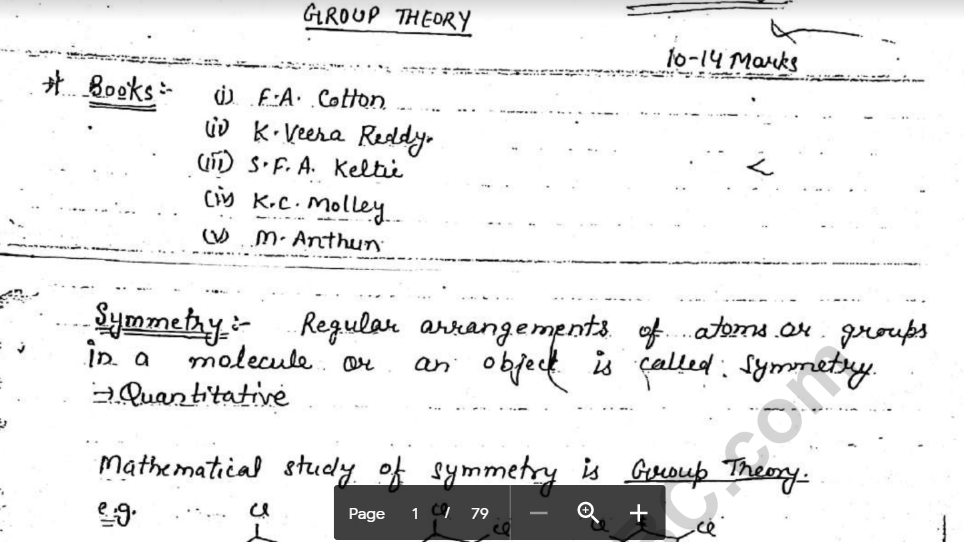
Group Theory Handwritten Notes PDF: Point Groups, Character Tables & Spectroscopy
Complete, high-yield classroom notes compiled from premier CSIR NET and GATE coaching toppers. Covers symmetry elements, point group classification flowcharts, Great Orthogonality Theorem (GOT), character tables, and IR/Raman vibrational analysis.
- 📥 Download Group Theory Notes (PDF Versions)
- 📌 Why Group Theory is a High-Scoring Unit
- 🔬 Core Topics Covered in These Notes
- 1. Symmetry Elements & Operations
- 2. Systematic Point Group Determination Flowchart
- 3. Great Orthogonality Theorem (GOT) & Character Tables
- 4. Mulliken Symbols for Irreducible Representations
- 5. Reduction Formula & Vibrational Spectroscopy (IR / Raman)
- 📊 Exam Weightage: Group Theory
- 🎯 Recommended Topper Revision Strategy
- 🔥 Most Downloaded Study Materials on ChemistryABC
- ❓ Frequently Asked Questions (FAQ)
📥 Download Group Theory Notes (PDF Versions)
Access high-quality PDF copies without subscription barriers:
Clean Scans • Hand-Drawn Character Tables • Mobile Friendly
📌 Why Group Theory is a High-Scoring Unit
In CSIR UGC NET Chemical Sciences and GATE Chemistry, Group Theory consistently contributes 8 to 14 marks. Unlike subjective topics, Group Theory is governed by strict mathematical symmetry theorems, meaning questions have definitive, unambiguous answers.
- Predictable Scoring: Direct formulas for irreducible representation reduction (Reducible to Irreducible via the Great Orthogonality Theorem).
- Spectroscopic Applications: Deciding active vibrational modes in IR and Raman spectroscopy using character tables.
- Molecular Orbital & Hybridization: Deriving symmetry-adapted linear combinations (SALCs) and predicting allowed electronic transitions.
- Companion Download: You can also download our popular Name Reagents Handwritten Notes PDF for organic conversions.
🔬 Core Topics Covered in These Notes
1. Symmetry Elements & Operations
- Identity (E): The “do-nothing” operation present in every molecule.
- Proper Rotation Axis (Cn): Rotation by an angle θ = 360° / n around an axis. (Principal axis has highest n).
- Plane of Symmetry (σ):
- Vertical Plane (σv): Contains the principal symmetry axis (e.g., in H2O, NH3).
- Horizontal Plane (σh): Perpendicular to the principal symmetry axis (e.g., in BF3, C6H6).
- Dihedral Plane (σd): Bisects the angle between two C2 axes perpendicular to the principal axis (e.g., in allene, ferrocene staggered).
- Center of Inversion (i): Inversion through a center point (x, y, z → −x, −y, −z). Found in trans-dichloroethylene, SF6, C6H6.
- Improper Rotation Axis / Alternating Axis (Sn): Rotation by 360° / n followed by reflection through a plane perpendicular to the rotation axis (Sn = Cn × σh). Notice that S1 = σ and S2 = i.
2. Systematic Point Group Determination Flowchart
- Linear Molecules:
- With center of inversion i (e.g., H2, CO2, C2H2) → D∞h
- Without center of inversion i (e.g., HCl, CO, HCN) → C∞v
- High Symmetry Cubic Groups: Tetrahedral (Td, e.g., CH4), Octahedral (Oh, e.g., SF6), Icosahedral (Ih, e.g., C60 fullerene).
- Molecules with n C2 axes ⊥ Principal Cn (Dihedral Groups):
- With σh → Dnh (e.g., BF3 is D3h, PtCl42− is D4h, Benzene is D6h)
- With σd (no σh) → Dnd (e.g., Allene is D2d, Staggered ethane is D3d)
- No planes → Dn
- Molecules without C2 ⊥ Principal Cn:
- With σh → Cnh (e.g., trans-N2F2 is C2h, Boric acid is C3h)
- With σv → Cnv (e.g., H2O is C2v, NH3 is C3v, PCl3 is C3v)
- No planes → Cn (e.g., H2O2 non-planar is C2)
- Low Symmetry Groups: C1 (no symmetry), Cs (only σ plane, e.g., SOCl2), Ci (only center of inversion, e.g., anti-1,2-dibromo-1,2-dichloroethane).
3. Great Orthogonality Theorem (GOT) & Character Tables
The Great Orthogonality Theorem is the foundation of group representation theory. The five key rules derived from GOT are:
- Sum of Squares of Dimensions: ∑ (li)2 = h, where h is the order of the group and li is the dimension of the i-th irreducible representation (IRR).
- Sum of Squares of Characters: For any irreducible representation, ∑ [ χi(R) ]2 = h.
- Orthogonality of Different IRRs: ∑ χi(R) χj(R) = 0 (when i ≠ j).
- Invariance in Conjugate Classes: The characters of all symmetry operations belonging to the same class are identical.
- Number of IRRs: The total number of irreducible representations equals the number of conjugate classes of operations in the group.
4. Mulliken Symbols for Irreducible Representations
- A: Singly degenerate, symmetric with respect to principal rotation axis [χ(Cn) = +1].
- B: Singly degenerate, antisymmetric with respect to principal axis [χ(Cn) = −1].
- E: Doubly degenerate representation (dimension = 2).
- T: Triply degenerate representation (dimension = 3).
- Subscripts 1 and 2: Symmetric (+1) or antisymmetric (−1) with respect to a C2 perpendicular to Cn (or σv in groups lacking C2 ⊥ Cn).
- Subscripts g and u: Gerade (symmetric, +1) or ungerade (antisymmetric, −1) with respect to center of inversion i.
- Primes ‘ and ”: Symmetric (+1) or antisymmetric (−1) with respect to horizontal reflection plane σh.
5. Reduction Formula & Vibrational Spectroscopy (IR / Raman)
ai = (1 / h) ∑ [ gR × χred(R) × χi(R) ]
Where h is group order, gR is the number of operations in class R, χred is the reducible character, and χi is the character of the irreducible representation.
- Total Degrees of Freedom: 3N (where N is the number of atoms).
- Vibrational Modes (Γvib): Γvib = Γ3N − Γtrans − Γrot.
For non-linear molecules: 3N − 6. For linear molecules: 3N − 5. - IR Activity: An irreducible representation is IR active if it transforms like translational coordinates (x, y, or z) in the character table.
- Raman Activity: An irreducible representation is Raman active if it transforms like quadratic products (x2, y2, z2, xy, xz, yz).
- Rule of Mutual Exclusion: For centrosymmetric molecules possessing an inversion center i (e.g., CO2, C2H4, SF6), transitions that are IR active are Raman inactive, and vice versa. No mode can be both IR and Raman active simultaneously.
📊 Exam Weightage: Group Theory
Mark distribution across competitive chemistry examinations:
| Examination | Type of Question | Average Questions | Total Marks |
|---|---|---|---|
| CSIR UGC NET (Part C) | 4-Mark Analytical (Character tables, IR/Raman, GOT) | 2 – 3 Questions | 8 – 12 Marks |
| CSIR UGC NET (Part B) | 2-Mark Factual (Point group, Mulliken notation) | 1 – 2 Questions | 2 – 4 Marks |
| GATE Chemistry | 1-Mark & 2-Mark MCQs / NATs | 2 – 4 Questions | 4 – 6 Marks |
| TIFR / BARC | Symmetry & Spectral Predictions | 2 – 3 Questions | 6 – 9 Marks |
🎯 Recommended Topper Revision Strategy
- Master Point Group Assignments for Tricky Molecules: Practice molecules with subtle planes such as allene (D2d), ferrocene (eclipsed: D5h, staggered: D5d), and H2O2 (cis: C2v, trans: C2h, non-planar: C2).
- Use the Reduction Formula with Confidence: Practice reducing Γ3N for water (C2v) and ammonia (C3v) manually without looking at answers until the arithmetic becomes effortless.
- Check the Rule of Mutual Exclusion First: In vibrational spectra questions, check immediately if the molecule has an inversion center (i). If it does, eliminate all options that suggest simultaneous IR and Raman activity for the same vibrational mode.
❓ Frequently Asked Questions (FAQ)
Version 1 is a 79-page comprehensive classroom notebook featuring step-by-step character table derivations and solved CSIR NET problems. The Arvind Version is a concise reference note ideal for fast revision before the examination.
The Rule of Mutual Exclusion states that for any molecule with a center of inversion (inversion center i), no normal mode of vibration can be active in both Infrared (IR) and Raman spectroscopy simultaneously. Modes that are IR active are Raman inactive, and vice versa.
Look at the linear functions column (the second-to-last column) of the character table. If the irreducible representation transforms as x, y, or z (which represent electric dipole moment vectors), that vibrational mode is IR active.


i need all chemistry notes of msc
MSc chemistry notes download pdf by searching in search box
It’s best way to learn chemistry