

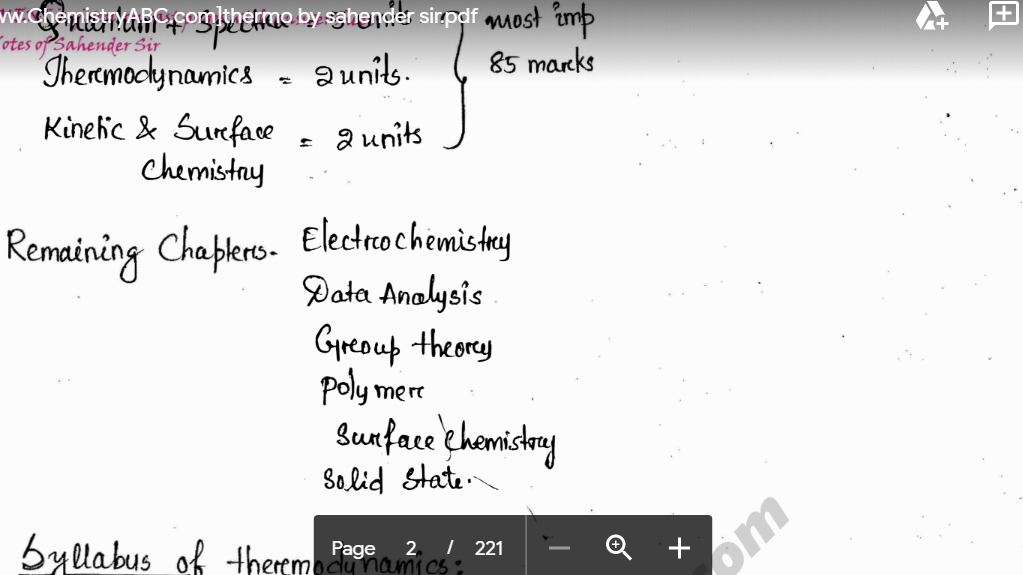
Chemical & Statistical Thermodynamics Handwritten Notes PDF (By Sahendra Sir)
Complete, high-yield classroom notes compiled by top rankers from Sahendra Sir’s coaching sessions. Covers classical laws of thermodynamics, Maxwell relations, Joule-Thomson expansion, statistical partition functions, and residual entropy calculations for CSIR NET & GATE.
- 📥 Download Thermodynamics Notes (PDF Versions)
- 📌 Why Thermodynamics is a Scoring Heavyweight
- 🔬 Core Topics Covered in These Notes
- 1. First Law of Thermodynamics & Thermochemistry
- 2. Second Law, Carnot Engine & Entropy Calculations
- 3. Maxwell Relations & Thermodynamic Equations of State
- 4. Phase Equilibria & Chemical Potential
- 5. Statistical Thermodynamics & Residual Entropy
- 📊 Exam Weightage: Thermodynamics
- 🎯 Recommended Topper Revision Strategy
- 🔥 Most Downloaded Study Materials on ChemistryABC
- ❓ Frequently Asked Questions (FAQ)
📥 Download Thermodynamics Notes (PDF Versions)
Choose your preferred download link below to save or read online:
Clean Handwritten Scans • High Resolution • 100% Free Study Material
📌 Why Thermodynamics is a Scoring Heavyweight
In CSIR UGC NET Chemical Sciences and GATE Chemistry, Classical and Statistical Thermodynamics collectively carry 16 to 24 marks. Unlike highly conceptual descriptive subjects, thermodynamics questions are strictly equation-governed, making them highly predictable and rewarding for prepared candidates.
- Direct Maxwell Relations: 4-mark Part C questions regularly ask for thermodynamic equations of state, internal pressure derivations, and Joule-Thomson inversion temperatures.
- Statistical Mechanics Shortcut Formulas: Questions on molecular partition functions (qtrans, qrot, qvib) and residual entropy follow standard algebraic rules.
- Zero Ambiguity: Numerical and conceptual problems have definitive mathematical answers, ensuring maximum scoring efficiency.
🔬 Core Topics Covered in These Notes
1. First Law of Thermodynamics & Thermochemistry
- State Functions vs. Path Functions: Exact vs. inexact differentials, Euler’s reciprocity condition, cyclic rule: (∂P/∂V)T (∂V/∂T)P (∂T/∂P)V = −1.
- Internal Energy (U) & Enthalpy (H): Heat capacity relations for ideal and real gases:Cp − Cv = T (∂P/∂T)V (∂V/∂T)P
For an ideal gas: Cp − Cv = R. For a van der Waals gas: Cp − Cv ≈ R [ 1 + (2a / RTV) ]. - Reversible vs. Irreversible Expansions: Work done in isothermal reversible expansion (w = −nRT ln(V2/V1)) versus irreversible expansion against constant external pressure; adiabatic reversible expansion (PVγ = constant, TVγ−1 = constant).
- Thermochemistry: Kirchhoff’s law of heat of reaction with temperature (ΔH2 − ΔH1 = ∫ ΔCp dT), Hess’s law, and bond enthalpy calculations.
2. Second Law, Carnot Engine & Entropy Calculations
- Carnot Cycle Efficiency (η):η = (−wnet / qh) = (Th − Tc) / Th = 1 − (Tc / Th)
- Clausius Inequality: ∮ (dq / T) ≤ 0 (equality holds for reversible processes, strict inequality for spontaneous irreversible processes).
- Entropy Changes for Ideal Gases:
- In terms of T and V: ΔS = Cv ln(T2 / T1) + R ln(V2 / V1)
- In terms of T and P: ΔS = Cp ln(T2 / T1) − R ln(P2 / P1)
- Phase transitions: ΔStrans = ΔHtrans / Ttrans (Trouton’s rule: ΔSvap ≈ 88 J K−1 mol−1 for non-associated liquids).
- Entropy of mixing of ideal gases: ΔSmix = −R ∑ ni ln xi (always positive, ΔGmix = −T ΔSmix < 0).
3. Maxwell Relations & Thermodynamic Equations of State
The four fundamental differential equations and their corresponding Maxwell relations:
- dU = TdS − PdV ⇒ (∂T/∂V)S = −(∂P/∂S)V
- dH = TdS + VdP ⇒ (∂T/∂P)S = (∂V/∂S)P
- dA = −SdT − PdV ⇒ (∂S/∂V)T = (∂P/∂T)V
- dG = −SdT + VdP ⇒ (∂S/∂P)T = −(∂V/∂T)P
πT = (∂U/∂V)T = T (∂P/∂T)V − P
For an ideal gas, πT = 0. For a van der Waals gas, πT = a / Vm2.
μJT = (∂T/∂P)H = (1 / Cp) [ T (∂V/∂T)P − V ]
Inversion Temperature: Ti = 2a / (Rb). At T < Ti, gas cools upon expansion (μJT > 0).
4. Phase Equilibria & Chemical Potential
- Clausius-Clapeyron Equation: ln(P2 / P1) = (ΔHvap / R) [ (1 / T1) − (1 / T2) ].
- Gibbs-Helmholtz Equation: [ ∂(ΔG / T) / ∂T ]P = −ΔH / T2.
- Gibbs-Duhem Equation: ∑ ni dμi = −SdT + VdP (at constant T and P: ∑ ni dμi = 0).
5. Statistical Thermodynamics & Residual Entropy
- Molecular Partition Functions (q):
- Translational: qtrans = [ (2πmkT)3/2 / h3 ] × V ∝ T3/2 V.
- Rotational: Linear molecules: qrot = kT / (σBhc) ∝ T. Non-linear molecules: qrot ∝ T3/2.
- Vibrational: qvib = 1 / [ 1 − exp(−hν / kT) ].
- Electronic: qelec = g0 + g1 exp(−Δε1 / kT).
- Canonical Partition Function (Q): For indistinguishable particles: Q = qN / N!. For distinguishable particles: Q = qN.
- Residual Entropy (Third Law of Thermodynamics): Calculated using Boltzmann’s formula: S0 = k ln W.
• Carbon monoxide (CO): 2 orientations ⇒ W = 2N ⇒ S0 = R ln 2 ≈ 5.76 J K−1 mol−1.
• Nitrous oxide (N2O): 2 orientations ⇒ W = 2N ⇒ S0 = R ln 2 ≈ 5.76 J K−1 mol−1.
• Ice (H2O): Pauling’s model with W = (3/2)N ⇒ S0 = R ln(1.5) ≈ 3.37 J K−1 mol−1.
📊 Exam Weightage: Thermodynamics
Mark distribution across competitive chemistry examinations:
| Examination | Type of Question | Average Questions | Total Marks |
|---|---|---|---|
| CSIR UGC NET (Part C) | 4-Mark Analytical (Maxwell relations, Statistical Thermo) | 3 – 5 Questions | 12 – 20 Marks |
| CSIR UGC NET (Part B) | 2-Mark Factual (Carnot η, Residual entropy, Work done) | 2 – 3 Questions | 4 – 6 Marks |
| GATE Chemistry | 1-Mark & 2-Mark MCQs / Numerical Answer Types (NATs) | 4 – 6 Questions | 7 – 10 Marks |
| BARC / TIFR | Classical Equations of State & Ensembles | 3 – 4 Questions | 9 – 12 Marks |
🎯 Recommended Topper Revision Strategy
- Draw the Thermodynamic Square (Mnemonic): Practice writing all four Maxwell relations and internal energy relations in under 30 seconds using the standard thermodynamic square mnemonic.
- Memorize Partition Function Dependencies on T: Remember that qtrans ∝ T3/2, qrot(linear) ∝ T, and qrot(non-linear) ∝ T3/2. These temperature dependencies appear frequently in GATE NAT questions.
- Differentiate Between Reversible and Irreversible Work: Always check if expansion occurs against constant external pressure (irreversible) or slowly in equilibrium (reversible) before choosing formulas.
❓ Frequently Asked Questions (FAQ)
Using Pauling’s hydrogen-bonding model, a water molecule in ice has 6 possible orientations but only 1/4 of them satisfy hydrogen-bonding requirements per pair, giving W = (3/2)N. The residual entropy is S0 = R ln(3/2) = R ln(1.5) ≈ 3.37 J K−1 mol−1.
For an ideal gas, the internal pressure πT = (∂U/∂V)T = 0 because there are no intermolecular attractive forces. For a van der Waals gas, πT = a / Vm2, reflecting intermolecular attractive interactions.
The inversion temperature (Ti) is given by Ti = 2a / (Rb), where a and b are van der Waals constants. When a gas expands below its inversion temperature (T < Ti), it experiences cooling (μJT > 0).

Due to thousands of students downloading so speed of this page may down or some time you will see the database errors.
Keep calm and revisit after some time if the page unavailable.
Sorry for the inconvenience caused.
Chemistry ABC team.
Very important notes of your hard work