
PGT Chemistry Guide: Eligibility, Syllabus & Mock Test
Your definitive roadmap to becoming a Post Graduate Teacher (PGT) in Chemistry. Explore comprehensive eligibility criteria, roles, recruitment examination patterns across KVS, NVS, DSSSB, and UP PGT, topic-wise syllabus weightage, and attempt our free full-length online practice test.
⚡ Start Free Online PGT Mock Test- 1. What is a PGT Chemistry Teacher? Key Roles & Responsibilities
- 2. Essential Eligibility Criteria & Educational Qualifications
- 3. Major PGT Recruitment Boards & Exam Patterns (UP PGT, KVS, NVS, DSSSB)
- 4. UP PGT Chemistry Exam Pattern & Selection Process Breakdown
- 5. Free PGT Chemistry Online Mock Test (Full Width)
- 6. Core PGT Chemistry Syllabus Modules
- 7. 4-Step Self-Preparation Strategy for High Selection Marks
- 8. Frequently Asked Questions (FAQs)
👨🏫 1. What is PGT Chemistry? Key Roles & Responsibilities
A Post Graduate Teacher (PGT) in Chemistry is a senior secondary school faculty member responsible for teaching Chemistry to Classes 11 and 12 (including Board Examinations and foundational coaching for NEET & JEE). PGT educators bridge school-level science with higher university education.
- Curriculum Delivery: Preparing structured lesson plans, interactive laboratory demonstrations, and conceptual assignments aligned with NCERT standards.
- Laboratory Management: Conducting practical experiments safely, managing chemical inventories, titration set-ups, and salt analysis sessions.
- Student Evaluation: Designing unit tests, term exams, and comprehensive board-level preparatory assessments.
- Academic Progress Tracking: Maintaining accurate academic logs, laboratory notebooks, and organizing remedial sessions for students needing additional guidance.
🎓 2. Essential Eligibility Criteria & Qualifications
To be eligible for PGT Chemistry vacancies across central and state government recruitment boards, candidates must fulfill the following mandatory qualifications:
| Parameter | Standard Requirement | Board Specific Rules |
|---|---|---|
| Educational Degree | Post-Graduate Master’s Degree (M.Sc.) in Chemistry / Applied Chemistry / Organic / Inorganic / Physical Chemistry | Minimum 50% aggregate marks from a recognized university. |
| Professional Degree | Bachelor of Education (B.Ed.) or integrated equivalent | Mandatory for KVS, NVS, DSSSB, and UP PGT. |
| TET / CTET Requirement | Not mandatory for PGT in most boards currently | CTET is generally required up to TGT level; PGT selections prioritize Post-Graduation + B.Ed. |
| Age Limits | Varies by board: KVS (Up to 40 yrs), NVS (Up to 40 yrs), DSSSB (Up to 36 yrs), UP PGT (21 to 60 yrs) | Standard statutory age relaxations apply for SC, ST, OBC, and PwD categories. |
🏫 3. Major PGT Recruitment Boards Comparison Matrix
Aspirants can target multiple prestigious recruitment bodies across India throughout the year:
| Recruitment Organization | Official Portal | Exam Structure | Negative Marking |
|---|---|---|---|
| Kendriya Vidyalaya Sangathan (KVS) | kvsangathan.nic.in | 180 MCQs • 180 Marks • Written + Professional Competency / Interview | No Negative Marking |
| Navodaya Vidyalaya Samiti (NVS) | navodaya.gov.in | 130 Subject & General MCQs + 20 Qualifying Language Marks | −0.25 Mark Penalty |
| Delhi Subordinate Services (DSSSB) | dsssb.delhi.gov.in | Tier-I (300 MCQs): 100 General + 200 Subject Specific | −0.25 Mark Penalty |
| UP Secondary Education (UPSESSB) | upsessb.pariksha.nic.in | 125 Subject Questions • 425 Written + 50 Interview + 25 Special Qual | No Negative Marking |
📝 4. UP PGT Chemistry Exam Pattern & Selection Process
The Uttar Pradesh Secondary Education Service Selection Board (UPSESSB) selection process evaluates candidates across three stages, totaling 500 Marks:
| Selection Component | Marks Weightage | Percentage | Details |
|---|---|---|---|
| Written Examination | 425 Marks | 85% | 125 Multiple Choice Questions (each question carries 3.4 marks). Duration: 2 Hours. |
| Personal Interview | 50 Marks | 10% | Evaluation of subject knowledge, teaching aptitude, and personality. |
| Special Qualifications | 25 Marks | 5% | Weightage for Ph.D./D.Phil. (10 marks), M.Ed. (10 marks), B.Ed. (5 marks), or National Sports achievements. |
| Total Selection Score | 500 Marks | 100% | Strictly based on combined merit ranking. |
Note: The exam pattern for PGT Shiksha Mitra / Ad hoc teachers incorporates statutory service weightage points per government regulations.
💻 Live Test: PGT Chemistry Free Online Mock Test
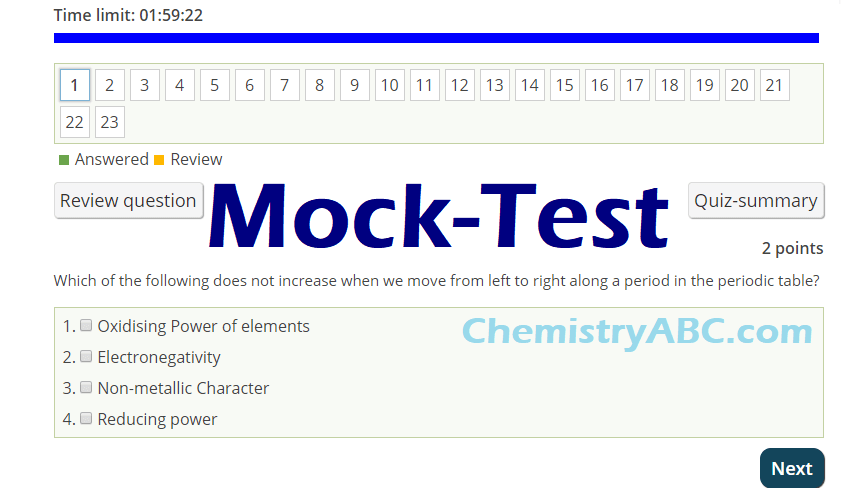
Interactive Practice PaperAttempt the mock test below to test your understanding of core organic mechanisms, physical formulas, and inorganic periodicity under real exam conditions:
Total number of questions : 20
Each question carries 1 mark
Negative marks of Each Questions: 0.25
Skipping questions, no marks will deduct.
Time allotted: 20 minutes

📖 5. High-Yield PGT Chemistry Syllabus Modules
The PGT syllabus bridges standard Class 11–12 NCERT concepts with Bachelor’s and Master’s level depth:
| Branch | High-Frequency Chapters | Key Scoring Focus Areas |
|---|---|---|
| Physical Chemistry | Chemical Kinetics, Thermodynamics, Electrochemistry, Atomic Structure, Solutions, Solid State | Integrated rate equations, Nernst equation, Kohlrausch’s law, colligative properties, de Broglie & Heisenberg principles. |
| Inorganic Chemistry | Periodic Properties, Chemical Bonding, Coordination Compounds, d- and f-Block Elements | VSEPR geometries, CFT crystal field splitting, magnetic moments, isomerism, Lanthanide contraction. |
| Organic Chemistry | GOC, Reaction Mechanisms, Hydrocarbons, Carbonyl Compounds, Amines, Biomolecules | Inductive & resonance effects, named reactions (Aldol, Cannizzaro, Reimer-Tiemann), R/S configuration, carbohydrates. |
🎯 6. 4-Step Self-Preparation Strategy for High Selection Marks
1. Master NCERT Classes 11 & 12 Line-by-Line: Nearly 60% of factual questions in PGT examinations stem directly from standard NCERT definitions, periodic trends, and textbook reactions.
2. Build Advanced M.Sc. Depth in Key Units: Complement school textbooks with standard university reference works (Puri-Sharma-Pathania for Physical, Huheey/Miessler for Inorganic, and Clayden/Morrison-Boyd for Organic).
3. Solve 10 Years of Previous Papers at Least 3 Times: Solving authentic PYQs from UP PGT, KVS, NVS, and DSSSB helps you identify repeated structural motifs and prevents common negative marking traps.
4. Daily 4 to 6 Hours Consistency: Consistent daily dedication of 4 to 6 hours over 4 to 6 months without skipping days is the proven path to securing top ranks in state and central teaching recruitments.
❓ 7. Frequently Asked Questions (FAQs)
For most premier central and state boards (including KVS, NVS, and UP PGT), a recognized B.Ed. degree is a mandatory requirement. Certain state boards occasionally permit candidates with exceptional postgraduate records or allow provisional enrollment subject to completing B.Ed. within a stipulated tenure.
No. Currently, the Central Teacher Eligibility Test (CTET) is conducted only for Primary (PRT / Paper 1) and Upper Primary / Trained Graduate (TGT / Paper 2) teachers. Post Graduate Teachers (PGT) do not require CTET in current recruitment notifications.
No. In the UP PGT examination conducted by UPSESSB, there is no negative marking. Each question carries equal positive marks (3.4 marks per question in the 125-question format), so candidates are encouraged to attempt all questions.

sir please provide pgt chemistry notes
Already posted.